

🌵Buyer's Advisory: Specialized Succulent Varieties
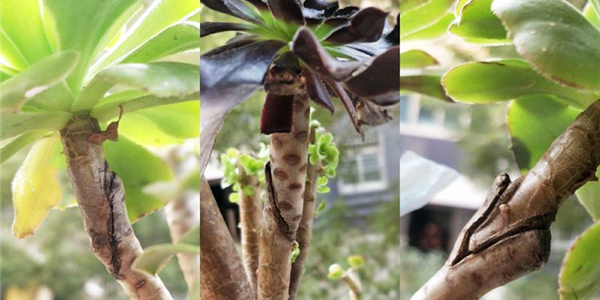
01. Grafted Succulents
Description: These are composite plants created by joining two different species.Grafted succulents are plants where the top part (scion) is grafted onto the rootstock (root base) of a different plant. This method is commonly used to enhance growth or enable the plant to survive in less-than-ideal soil conditions.Grafting ensures the survival and faster growth of the scion.
Notes:During long-haul international transport, especially when subjected to vibrations or temperature changes, Scion is prone to detaching from Rootstock. It is not easily preserved.
02. CITES Appendix II Species
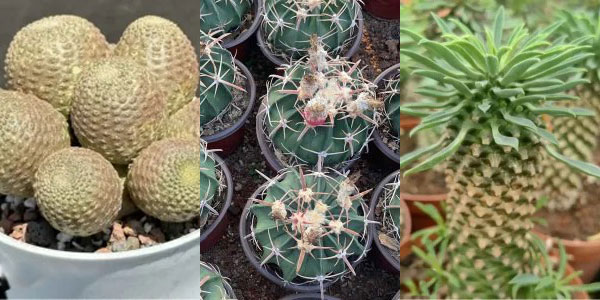
Description: This refers to species listed under CITES Appendix II (Convention on International Trade in Endangered Species of Wild Fauna and Flora). While not immediately threatened with extinction, they may become so if trade is not strictly controlled.
Notes:Export of these plants (even nursery-grown specimens) requires specific CITES Export Permits and often Import Permits from the destination country. (e.g., specific Astrophytum, certain Ariocarpus or Mammillaria.)
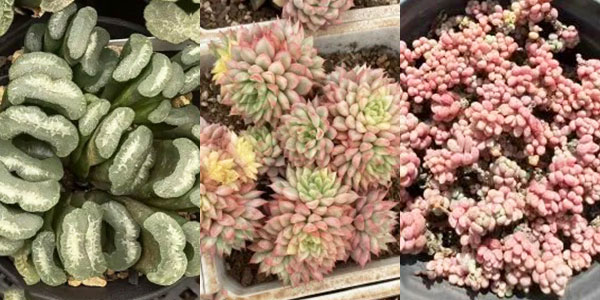
03. Clumping/Scattered Groups
Description: These are succulents that naturally produce numerous offsets (or pups) from the mother plant’s base or roots, forming a dense clump (a multi-headed group).
Notes:The term “Scattered Groups” refers to these natural clustering formations as opposed to a single solitary rosette. They are easily separated and scattered during transportation.
04. Chemically Induced Variegation
Description: This term refers to plants whose color change (variegation) is not a stable genetic mutation, but rather a temporary effect induced by environmental stress or chemical agents (often herbicides).
Notes:These colors are unstable and the plant is highly likely to revert back to its natural green color once the chemical stress subsides or new growth occurs. This is a critical distinction from Natural Genetic Variegation.
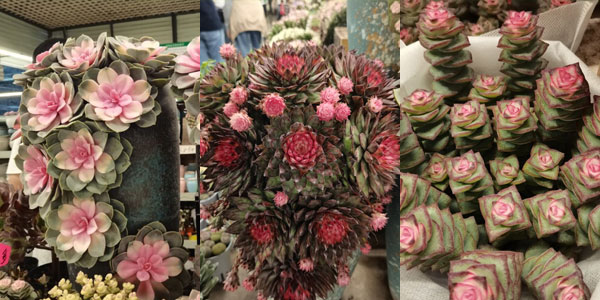
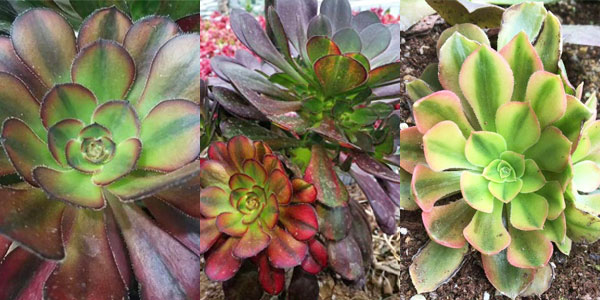
05. Marginal Variegation
Description:This is a stable form of Chimeral Variegation where the color mutation (the absence of chlorophyll) occurs uniformly along the edges (margins) of the leaves, creating a border or ‘frame’ of a different color (often yellow, white, or pink). The center of the leaf remains green.
Notes:Different from Sectoral Variegation (Random Patches) and Central Variegation (Color in the center). This pattern is typically considered more stable and desirable for commercial propagation.
Cactus Propagation Methods
🩹Crafted
- This is a composite plant where the desired top plant (scion) is joined to a different, often fast-growing base (rootstock).
- Tips:Limited lifespan; relatively fragile.
✂️Offset or Pup
- The plant is a natural clone taken from the mother plant's base or stem, guaranteeing the desired characteristics.
- Tips:The growth period will be long.
✅ Own-Roots
- This is a comprehensive term assuring you that the plant is established on its own native root system and is ungrafted.
- Tips:Uniform structure, stable root system.
🌱 Seed-Grown Roots
- The plant was grown directly from a seed, resulting in a robust primary taproot and the most genetically stable form.
- Tips:Long lifespan, strong vitality, expensive.